
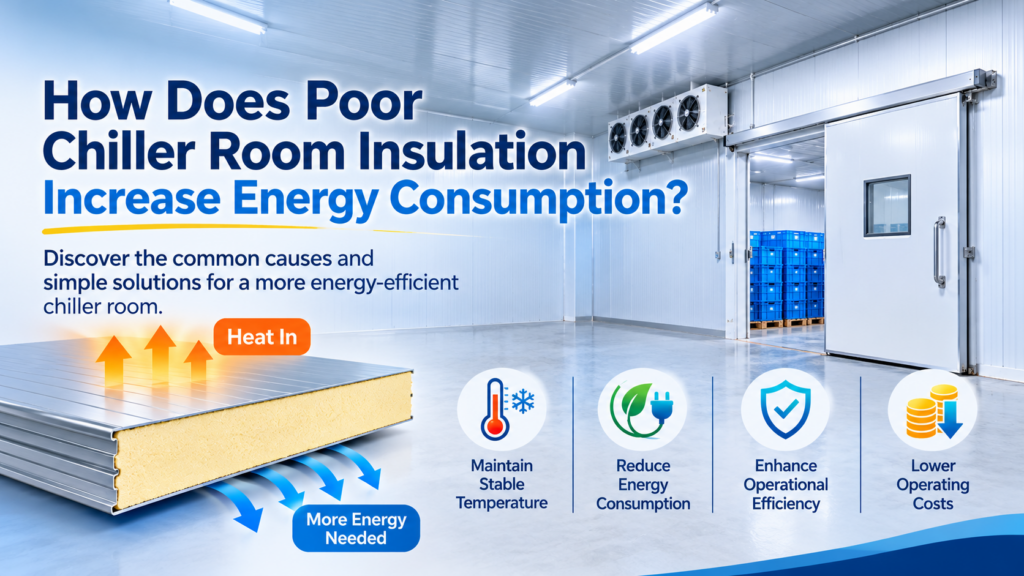
How Does Poor Chiller Room Insulation Increase Energy Consumption?
A chiller room plays an important role in maintaining controlled temperatures for industrial operations, food storage, manufacturing facilities and other temperature-sensitive applications.
However, maintaining the required temperature can become more challenging when the room has poor insulation, damaged panel joints or gaps around its doors. These issues allow unwanted heat to enter the room, increasing the cooling load and potentially causing the refrigeration system to work harder.
So, how does insulation affect chiller room energy consumption, and what should businesses consider when planning an efficient chiller room?
1. Understanding the Importance of Chiller Room Insulation
A chiller room is an insulated, temperature-controlled space designed to maintain a specified storage or operating temperature.
Its insulation system helps minimise heat transfer between the surrounding environment and the conditioned space.
Without suitable insulation, external heat can enter through:
Walls and ceiling panels
Floor insulation
Panel joints and connections
Door gaps and damaged seals
Other openings in the room structure
When more heat enters the room, the refrigeration system must remove that additional heat to maintain the required temperature.
This can increase cooling demand and contribute to higher energy consumption.
2. Five Common Causes of Energy Loss in a Chiller Room
A. Inadequate Insulation on Walls and Ceilings
Walls and ceilings form a major part of a chiller room’s thermal barrier.
If the insulation material or panel thickness is unsuitable for the application, more heat may pass through the room structure.
Polyurethane (PU) sandwich panels are commonly used in chiller rooms because their insulated core helps reduce heat transfer.
Choosing suitable panel specifications is important when designing a temperature-controlled environment.
B. Poorly Connected Panel Joints
Even when suitable insulated panels are used, poorly connected joints can create gaps in the room’s insulation barrier.
These gaps may allow warm air and moisture to enter, affecting the room’s temperature stability.
Proper panel connections and careful assembly help maintain the continuity of the insulated enclosure.
C. Frequent Door Opening
Every time a chiller room door opens, warmer surrounding air can enter the controlled space.
Frequent opening, prolonged loading activities and unnecessary door access may increase the amount of heat entering the room.
Businesses should consider their daily operating activities when selecting suitable door designs and planning access points.
D. Damaged Door Gaskets and Poor Sealing
Door sealing is another important factor in controlling unwanted heat transfer.
Damaged gaskets, loose seals or gaps around the door frame can compromise the insulated environment.
Regular inspection of door seals and ensuring proper door closure can help reduce unnecessary air exchange.
E. Unsuitable Insulation Specifications
Not every chiller room has the same operating requirements.
The appropriate insulation system depends on several factors, including:
Required room temperature
Room dimensions and layout
Type of products being stored
Frequency of door opening
Loading and unloading activities
Operating conditions and surrounding environment
Selecting panel thickness and construction details based on the actual application helps create a more suitable insulated space.
3. How Do PU Sandwich Panels Help Improve Chiller Room Insulation?
PU sandwich panels consist of a polyurethane foam core between metal facings.
The polyurethane core provides thermal insulation, helping minimise heat transfer through the room’s walls and ceiling.
These panels are widely used in:
Chiller rooms
Cold rooms
Freezer rooms
Food processing facilities
Temperature-controlled storage areas
Teck Chuan Industrial manufactures PU sandwich panels for cold room and chiller room applications, with different panel thicknesses and cladding options to suit project requirements.
However, overall insulation performance also depends on proper panel connections, room construction, door sealing and the suitability of the complete design.
4. Why Chiller Room Door Sealing Matters
An insulated room is only as effective as its overall enclosure.
Even with properly insulated walls and ceilings, poorly sealed doors can allow unwanted warm air to enter.
For industrial applications, businesses should consider:
Suitable insulated door construction
Proper door frame sealing
Well-maintained door gaskets
Appropriate door opening dimensions
Door designs that support daily loading activities
Selecting suitable insulated doors and maintaining their sealing components help support better temperature control.
5. What Should Businesses Consider Before Building a Chiller Room?
Before constructing or upgrading a chiller room, businesses should evaluate the requirements of their operations.
Important considerations include:
Temperature requirements: Identify the required operating and storage temperature.
Panel specifications: Select suitable PU panel thickness and facing materials.
Room dimensions: Consider the available space, storage capacity and layout.
Door selection: Choose suitable door types based on access frequency and loading activities.
Panel connections: Ensure proper joint connections to maintain insulation continuity.
Overall room design: Consider the refrigeration requirements, room usage and operating environment together.
A properly planned insulated enclosure can help reduce unwanted heat transfer and support more stable temperature conditions.
Build a Better-Insulated Chiller Room with Teck Chuan Industrial
Choosing suitable insulation materials is an important part of planning an effective chiller room.
At Teck Chuan Industrial, we manufacture PU sandwich panels for cold room, chiller room and other temperature-controlled applications. With different panel thicknesses and cladding options available, our products can support various industrial and commercial project requirements.
Looking for PU sandwich panels for your next chiller room project?
Contact Teck Chuan Industrial to discuss your project requirements and explore suitable insulation solutions.
Your One-Stop Cold Room Solutions.