
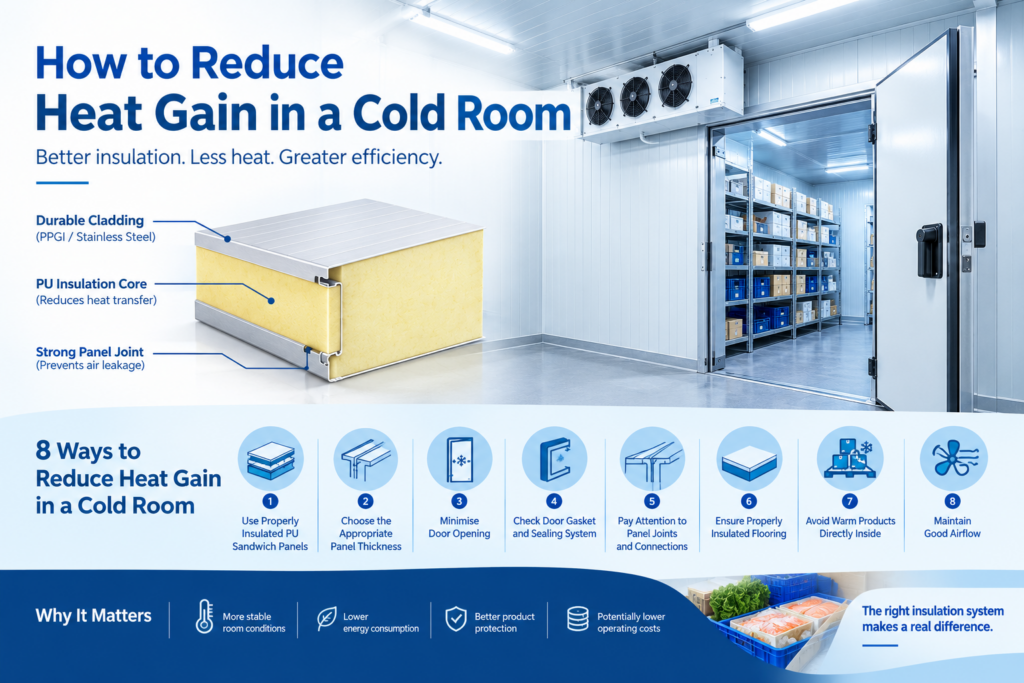
How to Reduce Heat Gain in a Cold Room
Maintaining a stable temperature is one of the most important factors in operating an efficient cold room. Whether the facility is used for food storage, seafood processing, pharmaceuticals, frozen products, or other temperature-sensitive applications, unwanted heat entering the room can increase the workload on the refrigeration system.
This unwanted heat is known as heat gain.
When heat continuously enters a cold room, the refrigeration system needs to work harder to remove it. Over time, this may affect temperature stability, energy consumption, equipment performance, and operating costs.
The good news is that heat gain can be managed through proper cold room design, insulation, door management, loading practices, and regular maintenance.
In this guide, we explain what causes heat gain in a cold room and practical ways to reduce it.
What Is Heat Gain in a Cold Room?
Heat gain refers to the amount of heat that enters a cold room from its surroundings or from activities taking place inside the room.
A cold room is designed to maintain a controlled environment that is colder than the surrounding area. Because heat naturally moves from warmer areas toward colder areas, heat will continuously try to enter the cold room.
Heat can enter through several pathways, including:
- Cold room walls and ceilings
- Floors
- Doors and door openings
- Panel joints and connections
- Gaps or damaged seals
- Warm products entering the room
- Air infiltration
- Poor insulation
- Lighting and other equipment inside the room
The refrigeration system must remove this heat to maintain the required room condition.
Therefore, reducing unnecessary heat gain can help improve the overall efficiency of a cold room system.
5 Ways to Reduce Heat Gain in a Cold Room
1. Use Properly Insulated PU Sandwich Panels
PU sandwich panels are commonly used for cold room applications because the insulated panel construction helps reduce heat transfer through the walls and ceiling.
A properly designed PU sandwich panel typically consists of an insulated polyurethane core between protective outer surfaces. When correctly selected and installed, the panel provides an effective barrier against external heat.
However, the performance of an insulated panel system does not depend only on the panel material. Proper thickness, installation, joints, doors, flooring, and overall room design also need to be considered.
2. Choose the Appropriate Panel Thickness
The thickness of the insulation panel is another important consideration.
Using an appropriate insulation thickness helps provide the thermal resistance required for the application.
Choosing a panel should therefore not simply be based on price. A suitable insulation specification should be determined according to the requirements of the project.
For example, Teck Chuan Industrial offers PU panels in various thicknesses, allowing panel specifications to be selected according to different cold room applications.
3. Minimize Unnecessary Door Opening
Cold room doors are one of the most common sources of heat gain.
Every time a cold room door is opened, warmer ambient air can enter while cold air escapes. The longer the door remains open, the greater the potential for air infiltration and heat gain.
This can be particularly significant in facilities where products are frequently moved in and out.
For facilities with frequent access, selecting an appropriate cold room door system and establishing good operating practices can make a significant difference.
4. Check the Door Gasket and Sealing System
A cold room door may be properly installed, but a damaged or poorly adjusted gasket can still allow warm air to enter.
The gasket creates a seal around the door when it is closed. If the gasket is damaged, compressed, loose, or no longer making proper contact with the frame, air leakage can occur.
Replacing damaged sealing components and ensuring the door closes properly can help reduce unwanted air infiltration.
5. Pay Attention to Panel Joints and Connections
Cold room insulation performance depends not only on the panel itself but also on how the panels are connected.
Poorly fitted joints, gaps, or improperly sealed connections can create areas where air infiltration or heat transfer may occur.
A properly constructed cold room should therefore have carefully fitted panel joints and connections. Proper installation is essential because even high-quality insulation materials may not perform as intended if the overall system is poorly assembled.
Why Reducing Heat Gain Matters ?
Reducing unnecessary heat gain is not simply about keeping the cold room cold.
It can contribute to several operational benefits.
1. More Stable Room Conditions
Reducing uncontrolled heat entering the room can make it easier for the refrigeration system to maintain the required operating conditions.
2. Reduced Refrigeration Workload
When less unnecessary heat enters the cold room, the refrigeration system has less heat to remove.
3. Better Energy Efficiency
Reducing avoidable heat loads can help improve the overall energy efficiency of the cold room system.
Actual energy savings will depend on the refrigeration system, room design, operating conditions, usage patterns, and other factors.
4. Better Protection of Stored Products
Maintaining appropriate and stable conditions is particularly important for temperature-sensitive products.
5. Potentially Lower Operating Costs
Improving insulation, reducing air infiltration, and adopting better operating practices may help reduce unnecessary refrigeration demand and associated operating costs.
How PU Sandwich Panels Help Reduce Heat Transfer
The insulation system is one of the fundamental components of a cold room.
PU sandwich panels are designed to create an insulated barrier between the internal cold environment and the warmer external surroundings.
The overall performance of a cold room panel system depends on several factors, including:
- Insulation material
- Panel thickness
- Panel construction
- Joint design
- Installation quality
- Door sealing
- Floor insulation
- Overall cold room design
For this reason, choosing the right panel is only one part of designing an efficient cold room. The complete insulated enclosure should be considered as a system.
Why Choose Teck Chuan Industrial for PU Sandwich Panels?
Teck Chuan Industrial is a Malaysian manufacturer specialising in PU sandwich panels and cold room solutions.
Our PU panels are designed for applications including cold rooms, cleanrooms, food processing rooms, and other temperature-controlled environments.
The panels are available in different thicknesses and cladding options to accommodate different project requirements.
Teck Chuan Industrial also offers SIRIM-certified PU Sandwich Panels for Cold Room applications, manufactured according to the applicable requirements of MS 1525:2019.
For businesses planning a new cold room or upgrading an existing facility, selecting the appropriate insulation system is an important step toward achieving reliable temperature control and efficient operation.
Need help selecting PU sandwich panels for your cold room project?
Contact Teck Chuan Industrial to discuss your project requirements and explore suitable PU panel solutions for your application.