
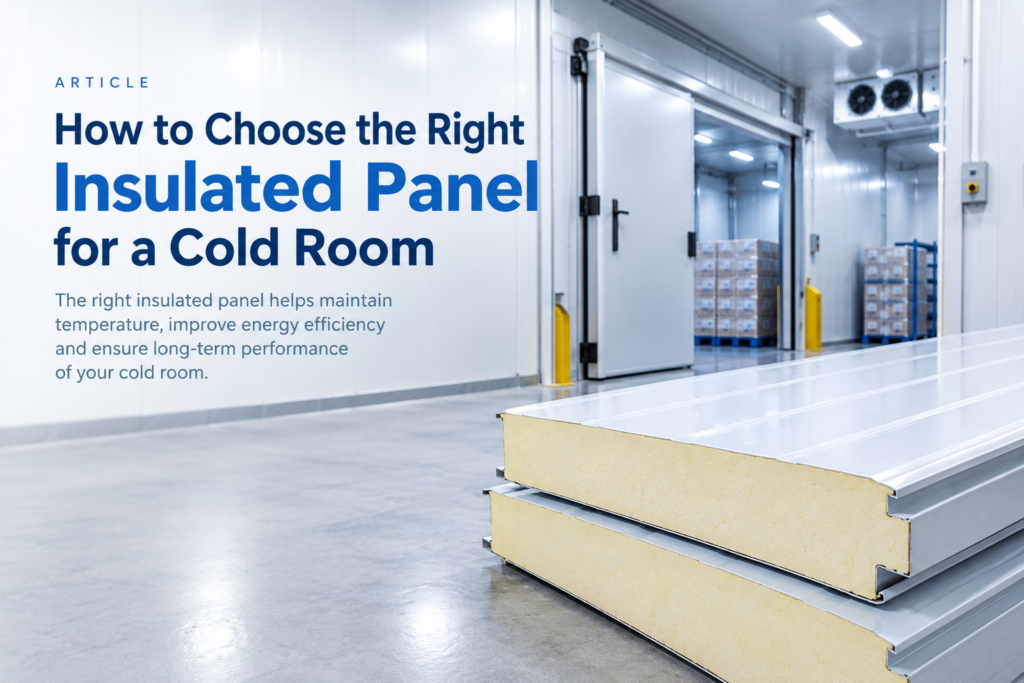
How to Choose the Right Insulated Panel for a Cold Room
Choosing the right insulated panel is one of the most important decisions when planning or upgrading a cold room. The panel forms the insulated enclosure of the room and plays an important role in maintaining the required internal conditions while reducing unwanted heat transfer.
However, not all insulated panels are the same. The right choice depends on factors such as the cold room application, insulation material, panel thickness, joint design, surface finish, hygiene requirements and overall construction quality.
For businesses in food processing, pharmaceuticals, agriculture, F&B and other temperature-controlled industries, selecting a suitable insulated panel can help improve cold room performance, durability and operational efficiency.
1. Understand the Cold Room Application
The first step is to identify how the cold room will be used.
Different applications have different requirements. For example, a cold room used for storing fresh produce may have different requirements from a freezer room, blast freezer or food processing area.
Consider:
What products will be stored?
How frequently will the room be accessed?
What type of products will enter and leave the room?
Is the room used for storage, processing or temporary holding?
What level of temperature control is required?
Will the room be exposed to frequent washing or cleaning?
Understanding the application helps determine the appropriate panel specification.
2. Choose the Appropriate Insulation Material
The insulation core is one of the key components of a sandwich panel.
For cold room applications, PU (polyurethane) sandwich panels are commonly used because they provide effective thermal insulation while offering a lightweight and practical construction solution.
A suitable insulation system helps reduce unwanted heat transfer between the cold room interior and surrounding environment.
When comparing panels, don’t look only at the appearance. Ask about the insulation core, its properties and how it is manufactured.
3. Consider the Panel Thickness
Panel thickness should be selected according to the application and required insulation performance.
A thicker panel is not automatically the best choice for every project. The appropriate thickness should be determined based on factors such as:
Cold room application
Required thermal performance
Room size
Operating conditions
Door opening frequency
Surrounding environment
Project specifications
It is therefore important to discuss the panel specification with a cold room specialist before making a final decision.
4. Check the Panel Joint and Locking System
The connection between panels is just as important as the panel itself.
A properly designed joint helps create a continuous insulated enclosure and minimises potential air leakage through panel connections.
For cold room construction, pay attention to:
Joint design
Panel alignment
Locking mechanism
Sealing between joints
Installation workmanship
Poorly connected panels can create gaps that affect the overall performance of the insulated enclosure.
5. Consider the Surface Material and Finish
Cold rooms, particularly those used in food and pharmaceutical-related environments, require surfaces that are practical to clean and maintain.
The panel surface should be selected according to the environment in which it will be used.
Important considerations include:
Smooth and easy-to-clean surfaces
Resistance to moisture
Durability
Hygiene requirements
Resistance to corrosion
Compatibility with cleaning procedures
For food processing environments, the panel system should also be considered together with the overall hygiene and facility requirements.
6. Look at Hygiene Requirements
If the cold room is used for food, pharmaceutical or other hygiene-sensitive applications, panel selection should take hygiene into account from the beginning.
A good cold room design should minimise areas where dirt, moisture or contaminants can accumulate.
This includes considering:
Panel joints
Corners
Floor-to-wall connections
Door openings
Sealing details
Internal surfaces
The insulated panel should form part of an overall hygienic cold room design rather than being considered as an isolated component.
7. Consider Durability
Cold room panels are exposed to daily operational activities. Forklifts, trolleys, pallets, cleaning activities and frequent door movement can all affect the condition of the room over time.
When selecting a panel, consider the expected operating environment and the level of physical activity around the room.
For busy facilities, protecting vulnerable areas such as corners, door openings and lower wall sections can help maintain the condition of the cold room.
8. Check Product Certification and Quality Standards
Certification is another important consideration when comparing insulated panels.
Instead of selecting a panel based only on price, ask the manufacturer about applicable standards, testing and certification.
Teck Chuan Industrial’s PU Sandwich Panel is SIRIM certified under MS 1525:2019, providing an additional reference point for customers evaluating panel quality and compliance.
When requesting a quotation, customers can ask the manufacturer to provide relevant product specifications and certification details for their project requirements.
9. Choose a Manufacturer That Understands Your Project
The insulated panel is only one part of a complete cold room system.
A manufacturer with experience in cold room solutions can help customers consider the panel together with other components such as:
Cold room doors
Floor systems
Panel joints
Internal and external finishes
Sealing details
Accessories
Room layout
This helps ensure that the selected panel specification is suitable for the overall project rather than simply choosing a standard panel based on price.
10. Don't Choose Based on Price Alone
Cost is naturally an important consideration for any project. However, the cheapest panel may not necessarily provide the most suitable long-term solution.
When comparing quotations, look beyond the price and compare:
Insulation material
Panel thickness
Panel specifications
Certification
Surface finish
Joint system
Manufacturing quality
Durability
Supplier experience
After-sales support
A proper comparison helps ensure that you are comparing equivalent specifications rather than simply comparing the lowest quotation.
Final Thoughts
Choosing the right insulated panel for a cold room involves more than selecting a thickness or comparing prices.
Consider the application, insulation material, panel thickness, joint system, surface finish, hygiene requirements, durability and certification before making your decision.
Most importantly, make sure the panel specification matches the actual requirements of your cold room.
The right insulated panel, combined with proper design and quality manufacturing, can help create a more effective and durable temperature-controlled environment.
Looking for the right insulated panel for your cold room project?
Contact Teck Chuan Industrial to discuss your project requirements and panel specifications.
Teck Chuan Industrial — Your One-Stop Cold Room Solutions.