
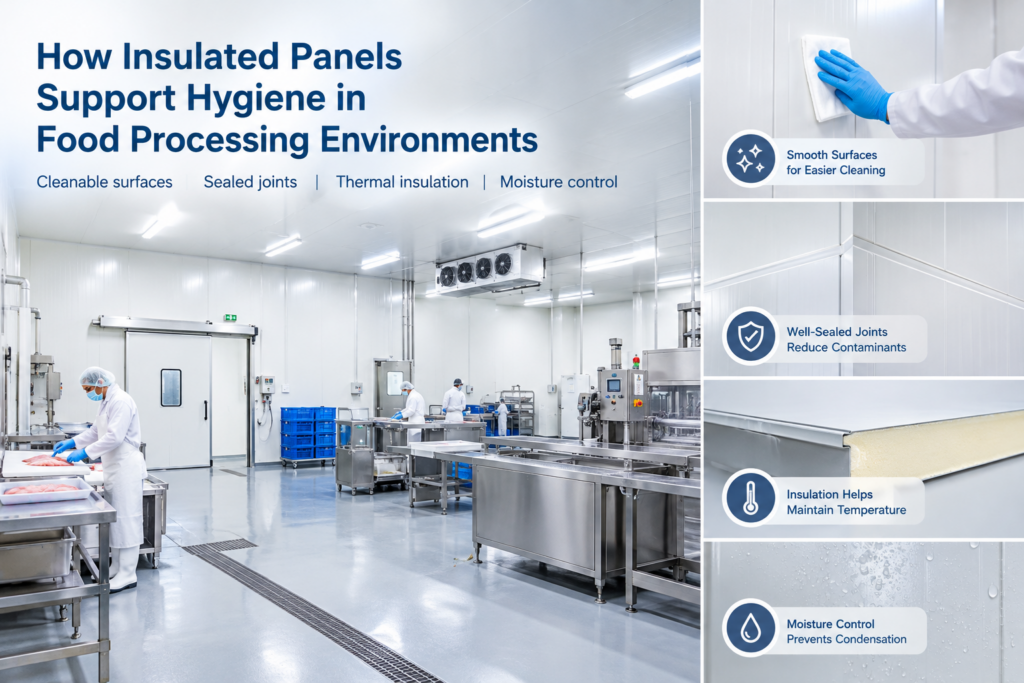
How Insulated Panels Support Hygiene in Food Processing Environments
Food hygiene is a critical consideration in food processing facilities. From meat and seafood processing plants to bakeries and central kitchens, maintaining a clean and well-controlled environment helps businesses protect product quality and support food safety practices.
One important consideration when designing these facilities is the selection of suitable wall and ceiling materials. Insulated sandwich panels are commonly used in food processing environments because they provide an enclosed surface, thermal insulation and design flexibility to meet different operational requirements.
But how do insulated panels contribute to hygiene, and what should businesses consider when selecting them?
1. Smooth Surfaces for Easier Cleaning
Wall and ceiling surfaces in food processing areas may be exposed to food splashes, moisture, grease and cleaning chemicals.
Insulated panels with suitable metal facings and surface finishes can provide smooth surfaces that are easier to wipe down and maintain than some unfinished construction materials.
When selecting panels for food processing facilities, businesses should consider:
Surface smoothness and cleanability
Resistance to the cleaning chemicals used on site
Suitability for the facility’s cleaning procedures
The condition and durability of the panel finish
The appropriate surface finish depends on the type of food processing, cleaning frequency and operating conditions.
2. Well-Sealed Joints Help Reduce Dirt and Moisture Accumulation
Panel joints are an important consideration in hygienic facility design.
Poorly sealed joints, gaps and damaged connections can create areas where moisture, dirt and food residues accumulate. These areas may be difficult to inspect and clean effectively.
Properly designed and sealed panel joints help create a more continuous internal surface, reducing potential locations where contaminants can collect.
For food processing facilities, attention should also be given to corners, wall-to-ceiling junctions, door openings and service penetrations. These details should be designed and finished to suit the facility’s hygiene requirements.
3. Insulation Helps Support Temperature Control
Temperature management is essential in many food processing operations, particularly where chilled ingredients, temperature-sensitive products or cold storage areas are involved.
Insulated sandwich panels help reduce heat transfer between the internal environment and the surrounding area. When incorporated into a properly designed and maintained facility, they can support the required temperature conditions.
Maintaining suitable temperatures can help businesses manage their processes and protect product quality.
However, panels alone do not control room temperature. Performance also depends on refrigeration capacity, room design, door usage, air circulation, loading practices and the surrounding environment.
4. Managing Condensation and Moisture
Condensation can become a concern when warm, humid air meets a sufficiently cold surface.
In food processing environments, excessive moisture may create additional cleaning challenges and affect the condition of building materials.
Appropriately specified insulation can help maintain internal surface temperatures and reduce the risk of condensation under suitable design conditions.
To manage moisture effectively, businesses should also consider:
Insulation continuity and thermal bridging
Proper sealing around joints and openings
Vapour control where required by the design
Room temperature and humidity conditions
Ventilation and process-related moisture sources
The correct combination of these measures depends on the facility’s operating conditions.
5. Durable Surfaces for Demanding Operating Conditions
Food processing facilities may require frequent cleaning, regular equipment movement and repeated exposure to moisture.
The durability of panel facings and joints is therefore an important selection factor.
Damaged coatings, exposed insulation cores and deteriorated seals may complicate cleaning and maintenance. Selecting suitable panel finishes and protecting them from operational damage can help preserve the condition of the facility’s internal surfaces.
Routine inspections are also important to identify scratches, corrosion, loose joints or other deterioration before these issues become more difficult to address.
6. Supporting HACCP and GMP Practices
HACCP (Hazard Analysis and Critical Control Points) and GMP (Good Manufacturing Practice) are important frameworks used in food safety management.
Building materials and facility design can support these practices by helping businesses establish environments that are easier to clean, maintain and manage.
Insulated panels may contribute to the physical design of a food processing facility, but their use alone does not establish HACCP or GMP compliance.
Businesses should evaluate the complete facility, including drainage, flooring, doors, equipment layout, cleaning procedures, pest prevention and other applicable requirements.
Panel specifications and installation details should be selected according to the facility’s intended use and relevant standards.
7. Choosing the Right Insulated Panels for Food Processing
Not every panel specification is suitable for every food processing environment. Before making a selection, businesses should assess their operational needs and the conditions the panels will encounter.
Consider the following questions:
What type of food will be processed or stored?
Will the area experience high humidity or frequent washdowns?
Which cleaning chemicals and methods will be used?
What internal and external temperatures are expected?
What surface finish and joint details are required?
What insulation thickness and thermal performance are appropriate?
What documentation or product certifications are required for the project?
Discussing these requirements with the panel manufacturer early in the planning process can help buyers specify suitable materials and avoid unnecessary changes later.
Final Thoughts
Insulated sandwich panels are an important consideration in the design of hygienic food processing environments. Their surface finishes, joint systems, insulation properties and durability can help support cleaning, moisture management and temperature control when properly specified and installed.
For businesses planning a new food processing facility or upgrading an existing one, choosing suitable panels should be part of a broader approach to hygienic design and food safety management.
Planning a food processing facility? Evaluate your panel specifications, surface finishes and joint details according to your operational and hygiene requirements before making a purchasing decision.
Contact Teck Chuan Industrial to discuss PU insulated panel solutions for your project.